Interface AnnotationRendererInterface
addAnnotationView(pView, pApplicationMatrix, pRenderingMask, pRenderingState): number;
addEventListener(pType, pListener, pObject): string;
addEventListener(pType, pListener): string;
areSignalsBlocked(): boolean;
asyncAddAnnotationView(pView, pApplicationMatrix, pRenderingMask, pRenderingState): Promise<AsyncAnnotationViewParsingResult>;
asyncWaitForAnnotationRequests(pRequestIds): Promise<AsyncAnnotationViewParsingResults>;
blockSignals(pBlock): void;
computeAnnotationsWorldAABB(pAnnotationIds, pDynamic, pAABB): boolean;
getAnnotationApplicationMatrix(pAnnotationId, pApplicationMatrix): boolean;
getAnnotationIds(pAnnotationIds): number;
getAnnotationLocalMatrix(pAnnotationId, pLocalMatrix): boolean;
getAnnotationLocalPlaneNormal(pAnnotationId, pLocalPlaneNormal): boolean;
getAnnotationLocalPlaneOrigin(pAnnotationId, pLocalPlaneOrigin): boolean;
getAnnotationLocalPlaneXAxis(pAnnotationId, pLocalPlaneXAxis): boolean;
getAnnotationLocalPlaneYAxis(pAnnotationId, pLocalPlaneYAxis): boolean;
getAnnotationRenderingState(pAnnotationId): number;
getAnnotationViewId(pAnnotationId): number;
getAnnotationWorldAABB(pAnnotationId, pDynamic, pAABB): boolean;
getAnnotationWorldMatrix(pAnnotationId, pWorldMatrix): boolean;
getAnnotationWorldPlaneNormal(pAnnotationId, pWorldPlaneNormal): boolean;
getAnnotationWorldPlaneOrigin(pAnnotationId, pWorldPlaneOrigin): boolean;
getAnnotationWorldPlaneXAxis(pAnnotationId, pWorldPlaneXAxis): boolean;
getAnnotationWorldPlaneYAxis(pAnnotationId, pWorldPlaneYAxis): boolean;
getAnnotationsRenderingState(pAnnotationIds, pAnnotationStates): boolean;
getViewAnnotationsCount(pViewId): number;
getViewApplicationMatrix(pViewId, pApplicationMatrix): boolean;
getViewFirstAnnotationId(pViewId): number;
getViewIds(pViewIds): number;
getViewLocalMatrix(pViewId, pLocalMatrix): boolean;
getViewLocalPlaneNormal(pViewId, pLocalPlaneNormal): boolean;
getViewLocalPlaneOrigin(pViewId, pLocalPlaneOrigin): boolean;
getViewLocalPlaneXAxis(pViewId, pLocalPlaneXAxis): boolean;
getViewLocalPlaneYAxis(pViewId, pLocalPlaneYAxis): boolean;
getViewWorldAABB(pViewId, pAABB): boolean;
getViewWorldMatrix(pViewId, pWorldMatrix): boolean;
getViewWorldPlaneNormal(pViewId, pWorldPlaneNormal): boolean;
getViewWorldPlaneOrigin(pViewId, pWorldPlaneOrigin): boolean;
getViewWorldPlaneXAxis(pViewId, pWorldPlaneXAxis): boolean;
getViewWorldPlaneYAxis(pViewId, pWorldPlaneYAxis): boolean;
hasEventListener(pType, pListener): boolean;
hasEventListenerById(pId): boolean;
isComputingAnnotations(): boolean;
removeAllAnnotations(): void;
removeAllEventListeners(): boolean;
removeAnnotationViews(pViews, pRemovedAnnotations?): number;
removeEventListener(pType, pListener, pObject): boolean;
removeEventListener(pType, pListener): boolean;
removeEventListenerById(pId): boolean;
setAnnotationRenderingState(pAnnotations, pRenderingMask, pRenderingState): boolean;
setAnnotationRenderingStateForAll(pRenderingMask, pRenderingState): boolean;
setViewApplicationMatrix(pViewId, pApplicationMatrix): boolean;
}
Hierarchy (view full)
- EventDispatcherInterface
- AnnotationRendererInterface
Index
Methods
Methods
add
- add
Annotation View(pView, pApplicationMatrix, pRenderingMask, pRenderingState): number Asynchronously adds an annotation view with a matrix, and sets the rendering state of the annotations contained within.
This function is asynchronous, the event AnnotationRendererInterfaceSignal.AnnotationViewParsed will be triggered shortly after with the result of the annotation view parsing.
If the function succeeds, a non zero value is returned, which is the id of the request, which should match the AnnotationViewParsingResultInterface.requestId of the correspondent signal.
If the function fails, 0 is returned and no signal will be triggered.
pApplicationMatrixMUST be a rotation / translation matrix (no scale), there is no check to ensure that the matrix is correct. You will experience some rendering and positioning trouble if pApplicationMatrix is not a rotation / translation matrix.An undefined value is equivalent to setting the default matrix of the view (AnnotationViewInterface.getDefaultMatrix). If AnnotationViewInterface.getDefaultMatrix is undefined, then an identity matrix will be set.
Parameters
- pView: AnnotationViewInterfaceinThe annotation view to include.
- pApplicationMatrix: Matrix4inThe matrix of the annotation view. An undefined value is equivalent to setting the default matrix of the view.
- pRenderingMask: numberinThe mask of the rendering state of all the annotations.
- pRenderingState: numberinThe rendering state of all the annotations.
Returns number
A non zero request id of the add procedure, 0 if there is an error.
- pView: AnnotationViewInterface
add
- add
Event Listener(pType, pListener, pObject): string Adds a listener to an event type.
When an event of the type
pTypefires, the callback pListener will be called. This function returns a unique string id that may be used in removeEventListenerById to allow simple listener removal. It is possible to add an object that will be included in the callback to avoid creating too many closures. Calling twice addEventListener with the same parameters results in the second call to be ignored, only unique pairs callback / object are allowed, in order to avoid calling multiple times the same thing.Parameters
- pType: stringinThe type of the event pListener will be called upon.
- pListener: tListenerCallbackinThe listener function that fires when the given event type occurs.
- pObject: ObjectinThe optional object the callback will be called with when the given event fires.
Returns string
The id of the inserted callback (actually an UUID).
- pType: string
- add
Event Listener(pType, pListener): string Adds a listener to an event type.
When an event of the type
pTypefires, the callback pListener will be called. This function returns a unique string id that may be used in removeEventListenerById to allow simple listener removal.Parameters
- pType: stringinThe type of the event pListener will be called upon.
- pListener: tListenerCallbackinThe listener function that fires when the given event type occurs.
Returns string
The id of the inserted callback (actually an UUID).
- pType: string
are
async
- async
Add Annotation View(pView, pApplicationMatrix, pRenderingMask, pRenderingState): Promise<AsyncAnnotationViewParsingResult> Asynchronously adds an annotation view with a matrix, and sets the rendering state of the annotations contained within with a promise.
A promise is returned.
pApplicationMatrixMUST be a rotation / translation matrix (no scale), there is no check to ensure that the matrix is correct. You will experience some rendering and positioning trouble if pApplicationMatrix is not a rotation / translation matrix.An undefined value is equivalent to setting the default matrix of the view (AnnotationViewInterface.getDefaultMatrix). If AnnotationViewInterface.getDefaultMatrix is undefined, then an identity matrix will be set.
Parameters
- pView: AnnotationViewInterfaceinThe annotation view to include.
- pApplicationMatrix: Matrix4inThe matrix of the annotation view. An undefined value is equivalent to setting the default matrix of the view.
- pRenderingMask: numberinThe mask of the rendering state of all the annotations.
- pRenderingState: numberinThe rendering state of all the annotations.
Returns Promise<AsyncAnnotationViewParsingResult>
A promise. The promise is resolved with the reason (success, cancelled, disposed, bad input). In case of success, the promise contains the parsing result.
- pView: AnnotationViewInterface
async
- async
Wait For Annotation Requests(pRequestIds): Promise<AsyncAnnotationViewParsingResults> Asynchronously waits for the given annotation parsing requests to complete.
A promise is returned.
Parameters
- pRequestIds: number[] | Uint32ArrayinThe annotation request ids to wait for being parsed.
Returns Promise<AsyncAnnotationViewParsingResults>
A promise. The promise is resolved with the reason (success, cancelled, disposed, bad input). In case of success, the promise contains an array of parsing results of
pRequestIds.- pRequestIds: number[] | Uint32Array
block
compute
- compute
Annotations WorldAABB(pAnnotationIds, pDynamic, pAABB): boolean Computes the Axis Aligned Bounding Box (AABB) of the given annotations.
Please note that the World Plane Origin of the view this annotation belongs to is not necessary contained in such an AABB since the annotation may be set with an offset from the Local Plane Origin (see getAnnotationWorldPlaneOrigin).
pIsDynamictells if the AABB should be updated depending on the current camera orientation. Indeed, some annotation(s) may be rendered as a billboard, and thus their bounding box should be a sphere centered on the pivot on the annotation.pIsDynamichas no effect on annotations that are not billboard-ed, the result is the same.If pDynamic is true, then the current orientation of billboard-ed annotation is taken into account, if false, a sphere centered on the pivot of the annotation is used to compute the AABB, and the result will always be the same for this annotation.
Returns true if all annotation ids are correct.
If the call fails, then pAABB is left unchanged.
Parameters
- pAnnotationIds: number[] | Uint32ArrayinThe
annotation idsof the annotations to fetch. - pDynamic: booleaninIf true, then billboard-ed annotation AABB is computed with the current camera orientation.
- pAABB: AABBoutThe resulting AABB of the given annotation.
Returns boolean
trueif pAnnotationIds refers to a valid annotations.- pAnnotationIds: number[] | Uint32Array
get
- get
Annotation Application Matrix(pAnnotationId, pApplicationMatrix): boolean Gets the application matrix set for the annotation view that contains this annotation.
Keep in mind that : WorldMatrix = ApplicationMatrix x LocalMatrix. This call gets the matrix set by the last call to addAnnotationView or setViewApplicationMatrix for the annotation view this annotation belongs to.
pApplicationMatrixwill be a rotation / translation matrix (no scale).Returns true if the application matrix for the view that contains the given annotation id has been retrieved, false if pAnnotationId is invalid or refer to a nonexistent annotation, in this last case,
pApplicationMatrixis left unchanged.This call is equivalent to calling getViewApplicationMatrix(getAnnotationViewId(pAnnotationId), pApplicationMatrix).
Parameters
- pAnnotationId: numberinThe
annotation idof the annotation to fetch. - pApplicationMatrix: Matrix4outThe application matrix for the view that contains the given annotation id.
Returns boolean
trueif the application matrix of the given annotation has been retrieved.- pAnnotationId: number
get
- get
Annotation Ids(pAnnotationIds): number Gets all the annotation ids handled by this annotation renderer.
Calling
getAnnotationIds(undefined)will return the number of annotations currently handled. Calling getAnnotationIds with an Uint32Array without sufficient length will return -1.Returns the number of annotations handled by the annotation renderer, or -1 if pAnnotationIds is a Uint32Array without sufficient memory.
Parameters
- pAnnotationIds: number[] | Uint32ArrayoutThe ids of the annotation views.
Returns number
The number of annotations handled by the annotation renderer, or -1 if pAnnotationIds is a Uint32Array without sufficient memory.
- pAnnotationIds: number[] | Uint32Array
get
- get
Annotation Local Matrix(pAnnotationId, pLocalMatrix): boolean Gets the Local matrix for the annotation view that contains this annotation.
Keep in mind that : WorldMatrix = ApplicationMatrix x LocalMatrix. This call gets the immutable Local matrix of the annotation view that contains this annotation, as retrieved with AnnotationViewInterface.getPlaneXAxis, AnnotationViewInterface.getPlaneYAxis, AnnotationViewInterface.getPlaneNormal, AnnotationViewInterface.getPlaneOrigin.
pLocalMatrixwill be a rotation / translation matrix (no scale).Returns true if the Local matrix for the view that contains this annotation has been retrieved, false if pAnnotationId is invalid or refer to a nonexistent annotation, in this last case,
pLocalMatrixis left unchanged.This call is equivalent to calling getViewLocalMatrix(getAnnotationViewId(pAnnotationId), pLocalMatrix).
Parameters
- pAnnotationId: numberinThe
annotation view idof the annotation to fetch. - pLocalMatrix: Matrix4outThe Local matrix for the view that contains the given annotation id.
Returns boolean
trueif the Local matrix of the given annotation has been retrieved.- pAnnotationId: number
get
- get
Annotation Local Plane Normal(pAnnotationId, pLocalPlaneNormal): boolean Gets the normal part of the Local matrix for the annotation view that contains this annotation.
getAnnotationLocalPlaneNormal(pAnnotationId, pLocalPlaneNormal)is equivalent to getAnnotationLocalMatrix(pAnnotationId, lMatrix), lMatrix.getColumn(2, pLocalPlaneNormal).Keep in mind that : WorldMatrix = ApplicationMatrix x LocalMatrix.
Returns true if the Local Plane Normal for the view that contains this annotation has been retrieved, false if pAnnotationId is invalid or refer to a nonexistent annotation, in this last case, pLocalPlaneNormal is left unchanged.
This call is equivalent to calling getViewLocalPlaneNormal(getAnnotationViewId(pAnnotationId), pLocalPlaneNormal).
Parameters
- pAnnotationId: numberinThe
annotation idof the annotation to fetch. - pLocalPlaneNormal: Vector3outThe Local Plane Normal for the view that contains the given annotation id.
Returns boolean
trueif the Local Plane Normal of the given annotation has been retrieved.- pAnnotationId: number
get
- get
Annotation Local Plane Origin(pAnnotationId, pLocalPlaneOrigin): boolean Gets the translation part of the Local matrix for the annotation view that contains this annotation.
This is therefore the Local Plane Origin.
getAnnotationLocalPlaneOrigin(pAnnotationId, pLocalPlaneOrigin)is equivalent to getAnnotationLocalMatrix(pAnnotationId, lMatrix), lMatrix.getColumn(3, pLocalPlaneOrigin).Keep in mind that : WorldMatrix = ApplicationMatrix x LocalMatrix.
Returns true if the Local Plane Origin for the view that contains this annotation has been retrieved, false if pAnnotationId is invalid or refer to a nonexistent annotation, in this last case, pLocalPlaneOrigin is left unchanged.
This call is equivalent to calling getViewLocalPlaneOrigin(getAnnotationViewId(pAnnotationId), pLocalPlaneOrigin).
Parameters
- pAnnotationId: numberinThe
annotation idof the annotation to fetch. - pLocalPlaneOrigin: Vector3outThe Local Plane Origin for the view that contains the given annotation id.
Returns boolean
trueif the Local Plane Origin of the given annotation has been retrieved.- pAnnotationId: number
get
- get
Annotation Local PlaneXAxis(pAnnotationId, pLocalPlaneXAxis): boolean Gets the X Axis direction of the Local matrix for the annotation view that contains this annotation.
getAnnotationLocalPlaneXAxis(pAnnotationId, pLocalPlaneXAxis)is equivalent to getAnnotationLocalMatrix(pAnnotationId, lMatrix), lMatrix.getColumn(0, pLocalPlaneXAxis).Keep in mind that : WorldMatrix = ApplicationMatrix x LocalMatrix.
Returns true if the Local Plane X Axis direction for the view that contains this annotation has been retrieved, false if pAnnotationId is invalid or refer to a nonexistent annotation, in this last case, pLocalPlaneXAxis is left unchanged.
This call is equivalent to calling getViewLocalPlaneXAxis(getAnnotationViewId(pAnnotationId), pLocalPlaneXAxis).
Parameters
- pAnnotationId: numberinThe
annotation idof the annotation to fetch. - pLocalPlaneXAxis: Vector3outThe Local Plane X Axis direction for the view that contains the given annotation id.
Returns boolean
trueif the Local Plane X Axis direction of the given annotation has been retrieved.- pAnnotationId: number
get
- get
Annotation Local PlaneYAxis(pAnnotationId, pLocalPlaneYAxis): boolean Gets the Y Axis direction of the Local matrix for the annotation view that contains this annotation.
getAnnotationLocalPlaneYAxis(pAnnotationId, pLocalPlaneYAxis)is equivalent to getAnnotationLocalMatrix(pAnnotationId, lMatrix), lMatrix.getColumn(1, pLocalPlaneYAxis).Keep in mind that : WorldMatrix = ApplicationMatrix x LocalMatrix.
Returns true if the Local Plane Y Axis direction for the view that contains this annotation has been retrieved, false if pAnnotationId is invalid or refer to a nonexistent annotation, in this last case, pLocalPlaneYAxis is left unchanged.
This call is equivalent to calling getViewLocalPlaneYAxis(getAnnotationViewId(pAnnotationId), pLocalPlaneYAxis).
Parameters
- pAnnotationId: numberinThe
annotation idof the annotation to fetch. - pLocalPlaneYAxis: Vector3outThe Local Plane Y Axis direction for the view that contains the given annotation id.
Returns boolean
trueif the Local Plane Y Axis direction of the given annotation has been retrieved.- pAnnotationId: number
get
- get
Annotation Rendering State(pAnnotationId): number Gets the rendering state of the given annotation.
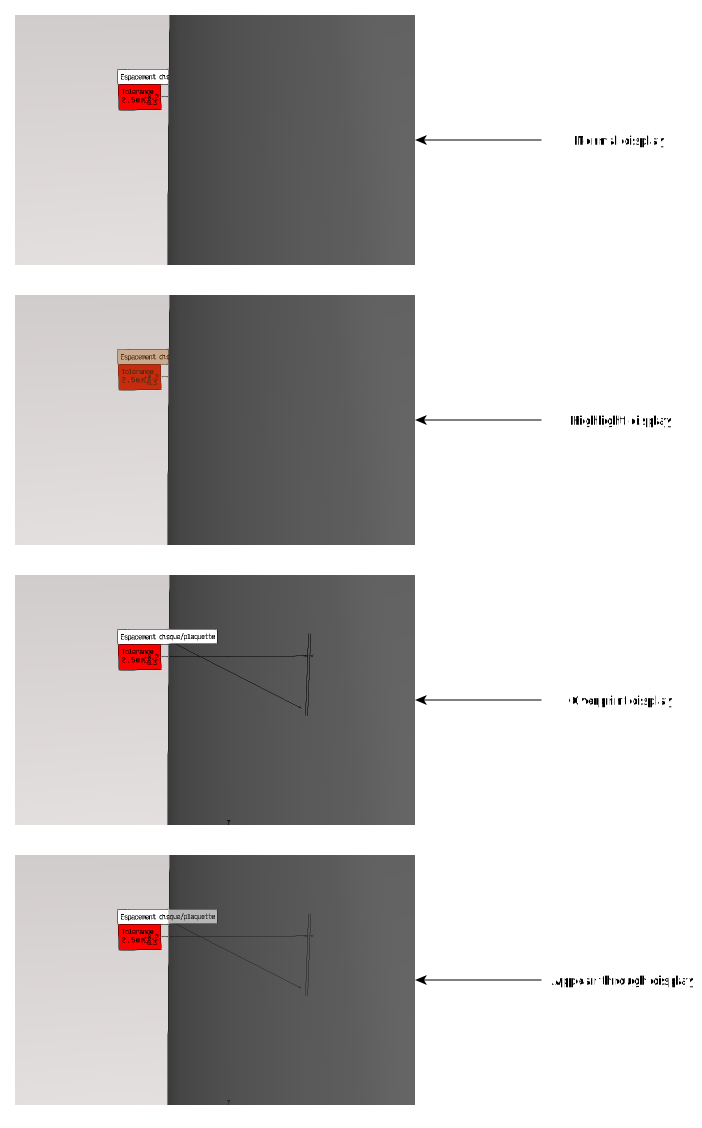
Returns an `OR`ed value of AnnotationInstanceState that reflect the rendering of the given annotation, or AnnotationInstanceState.AIS_Invalid if the given `annotation id` does not exist.Parameters
- pAnnotationId: numberinThe id of the annotation to fetch.
Returns number
The annotation state of the given annotation, or AnnotationInstanceState.AIS_Invalid if pAnnotationId refers to an invalid or nonexistent annotation id.
- pAnnotationId: number
get
- get
Annotation View Id(pAnnotationId): number Gets the annotation view id this annotation belongs to.
getAnnotationViewId({@link getViewFirstAnnotationId}(pViewId))should return pViewId.Returns the annotation view id of the given annotation, or -1 if pAnnotationId could not be found (i.e. no annotation in the AnnotationRendererInterface has this id).
Parameters
- pAnnotationId: numberinThe
annotation idof the annotation to fetch.
Returns number
The annotation view id this annotation belongs to, or -1 if pAnnotationId could not be found.
- pAnnotationId: number
get
- get
Annotation WorldAABB(pAnnotationId, pDynamic, pAABB): boolean Gets the Axis Aligned Bounding Box (AABB) of the given annotation.
Please note that the World Plane Origin of the view this annotation belongs to is not necessary contained in such an AABB since the annotation may be set with an offset from the Local Plane Origin (see getAnnotationWorldPlaneOrigin).
pIsDynamictells if the AABB should be updated depending on the current camera orientation. Indeed, some annotation(s) may be rendered as a billboard, and thus their bounding box should be a sphere centered on the pivot on the annotation.pIsDynamichas no effect on annotations that are not billboard-ed, the result is the same.If pDynamic is true, then the current orientation of billboard-ed annotation is taken into account, if false, a sphere centered on the pivot of the annotation is used to compute the AABB, and the result will always be the same for this annotation.
Returns true if pAnnotationId refers to a known annotation and pAABB is updated.
If the call fails, then pAABB is left unchanged.
Parameters
- pAnnotationId: numberinThe
annotation idof the annotation to fetch. - pDynamic: booleaninIf true, then billboard-ed annotation AABB is computed with the current camera orientation.
- pAABB: AABBoutThe resulting AABB of the given annotation.
Returns boolean
trueif pAnnotationId refers to a valid annotation.- pAnnotationId: number
get
- get
Annotation World Matrix(pAnnotationId, pWorldMatrix): boolean Gets the computed World matrix for the annotation view that contains this annotation.
Keep in mind that : WorldMatrix = ApplicationMatrix x LocalMatrix. This call computes the matrix set by the last call to addAnnotationView or setViewApplicationMatrix with the Local Matrix for the annotation view this annotation belongs to.
pWorldMatrixwill be a rotation / translation matrix (no scale).Returns true if the World matrix for the view that contains the given annotation id has been retrieved, false if pAnnotationId is invalid or refer to a nonexistent annotation, in this last case,
pWorldMatrixis left unchanged.This call is equivalent to calling getViewWorldMatrix(getAnnotationViewId(pAnnotationId), pWorldMatrix).
Parameters
- pAnnotationId: numberinThe
annotation idof the annotation to fetch. - pWorldMatrix: Matrix4outThe World matrix for the view that contains the given annotation id.
Returns boolean
trueif the World matrix of the given annotation has been retrieved.- pAnnotationId: number
get
- get
Annotation World Plane Normal(pAnnotationId, pWorldPlaneNormal): boolean Gets the normal part of the computed World matrix for the annotation view that contains this annotation.
getAnnotationWorldPlaneNormal(pAnnotationId, pWorldPlaneNormal)is equivalent to getAnnotationWorldMatrix(pAnnotationId, lMatrix), lMatrix.getColumn(2, pWorldPlaneNormal).Keep in mind that : WorldMatrix = ApplicationMatrix x LocalMatrix.
Returns true if the World Plane Normal for the view that contains this annotation has been retrieved, false if pAnnotationId is invalid or refer to a nonexistent annotation, in this last case, pWorldPlaneNormal is left unchanged.
This call is equivalent to calling getViewWorldPlaneNormal(getAnnotationViewId(pAnnotationId), pWorldPlaneNormal).
Parameters
- pAnnotationId: numberinThe
annotation idof the annotation to fetch. - pWorldPlaneNormal: Vector3outThe World Plane Normal for the view that contains the given annotation id.
Returns boolean
trueif the World Plane Normal of the given annotation has been retrieved.- pAnnotationId: number
get
- get
Annotation World Plane Origin(pAnnotationId, pWorldPlaneOrigin): boolean Gets the translation part of the computed World matrix for the annotation view that contains this annotation.
This is therefore the World Plane Origin.
getAnnotationWorldPlaneOrigin(pAnnotationId, pWorldPlaneOrigin)is equivalent to getAnnotationWorldMatrix(pAnnotationId, lMatrix), lMatrix.getColumn(3, pWorldPlaneOrigin).Keep in mind that : WorldMatrix = ApplicationMatrix x LocalMatrix.
Returns true if the World Plane Origin for the view that contains this annotation has been retrieved, false if pAnnotationId is invalid or refer to a nonexistent annotation, in this last case, pWorldPlaneOrigin is left unchanged.
This call is equivalent to calling getViewWorldPlaneOrigin(getAnnotationViewId(pAnnotationId), pWorldPlaneOrigin).
Parameters
- pAnnotationId: numberinThe
annotation idof the annotation to fetch. - pWorldPlaneOrigin: Vector3outThe World Plane Origin for the view that contains the given annotation id.
Returns boolean
trueif the World Plane Origin of the given annotation has been retrieved.- pAnnotationId: number
get
- get
Annotation World PlaneXAxis(pAnnotationId, pWorldPlaneXAxis): boolean Gets the X axis direction of the computed World matrix for the annotation view that contains this annotation.
getAnnotationWorldPlaneXAxis(pAnnotationId, pWorldPlaneXAxis)is equivalent to getAnnotationWorldMatrix(pAnnotationId, lMatrix), lMatrix.getColumn(0, pWorldPlaneXAxis).Keep in mind that : WorldMatrix = ApplicationMatrix x LocalMatrix.
Returns true if the World Plane X axis direction for the view that contains this annotation has been retrieved, false if pAnnotationId is invalid or refer to a nonexistent annotation, in this last case, pWorldPlaneXAxis is left unchanged.
This call is equivalent to calling getViewWorldPlaneXAxis(getAnnotationViewId(pAnnotationId), pWorldPlaneXAxis).
Parameters
- pAnnotationId: numberinThe
annotation idof the annotation to fetch. - pWorldPlaneXAxis: Vector3outThe World Plane X axis direction for the view that contains the given annotation id.
Returns boolean
trueif the World Plane X axis direction of the given annotation has been retrieved.- pAnnotationId: number
get
- get
Annotation World PlaneYAxis(pAnnotationId, pWorldPlaneYAxis): boolean Gets the Y axis direction of the computed World matrix for the annotation view that contains this annotation.
getAnnotationWorldPlaneYAxis(pAnnotationId, pWorldPlaneYAxis)is equivalent to getAnnotationWorldMatrix(pAnnotationId, lMatrix), lMatrix.getColumn(1, pWorldPlaneYAxis).Keep in mind that : WorldMatrix = ApplicationMatrix x LocalMatrix.
Returns true if the World Plane Y axis direction for the view that contains this annotation has been retrieved, false if pAnnotationId is invalid or refer to a nonexistent annotation, in this last case, pWorldPlaneYAxis is left unchanged.
This call is equivalent to calling getViewWorldPlaneYAxis(getAnnotationViewId(pAnnotationId), pWorldPlaneYAxis).
Parameters
- pAnnotationId: numberinThe
annotation idof the annotation to fetch. - pWorldPlaneYAxis: Vector3outThe World Plane Y axis direction for the view that contains the given annotation id.
Returns boolean
trueif the World Plane Y axis direction of the given annotation has been retrieved.- pAnnotationId: number
get
- get
Annotations Rendering State(pAnnotationIds, pAnnotationStates): boolean Gets the rendering state of the given annotations.
Stores an
ORed value of AnnotationInstanceState that reflect the rendering of the given annotation, or AnnotationInstanceState.AIS_Invalid if the givenannotation iddoes not exist in pAnnotationStates.If pAnnotationStates is an Uint32Array and its length is strictly inferior to pAnnotationIds.length, then only pAnnotationStates.length values will be computed (the first pAnnotationStates.length values of pAnnotationIds).
pAnnotationStates[i]will contain the rendering state of pAnnotationIds[i].Parameters
- pAnnotationIds: number[] | Uint32ArrayinThe ids of the annotations to fetch.
- pAnnotationStates: number[] | Uint32ArrayoutThe annotation states of the annotations. Any value equal to AnnotationInstanceState.AIS_Invalid means the annotation state of the given annotation could not be fetched.
Returns boolean
trueif the call succeeded, if an error occurred,falseis returned.- pAnnotationIds: number[] | Uint32Array
get
- get
View Annotations Count(pViewId): number Gets the number of annotations contained within the given annotation view.
Annotations contained within this annotation view are numbered from (including) getViewFirstAnnotationId(pViewId) to getViewFirstAnnotationId(pViewId) + getViewAnnotationsCount(pViewId) - 1.
Returns the number of annotations contained within the given annotation view, or -1 if pViewId could not be found.
Parameters
- pViewId: numberinThe
annotation view idof the annotation view to fetch.
Returns number
The number of annotations contained within the given annotation view, or -1 if pViewId could not be found.
- pViewId: number
get
- get
View Application Matrix(pViewId, pApplicationMatrix): boolean Gets the application matrix set for the given annotation view.
Keep in mind that : WorldMatrix = ApplicationMatrix x LocalMatrix. This call gets the matrix set by the last call to addAnnotationView or setViewApplicationMatrix for the given annotation view.
pApplicationMatrixwill be a rotation / translation matrix (no scale).Returns true if the application matrix for the given view has been retrieved, false if pViewId is invalid or refer to a nonexistent annotation view, in this last case, pApplicationMatrix is left unchanged.
This call is equivalent to calling getAnnotationApplicationMatrix(getViewFirstAnnotationId(pViewId), pApplicationMatrix).
Parameters
- pViewId: numberinThe
annotation view idof the annotation view to fetch. - pApplicationMatrix: Matrix4outThe application matrix for the given view.
Returns boolean
trueif the application matrix of the given annotation view has been retrieved.- pViewId: number
get
- get
View First Annotation Id(pViewId): number Gets the start annotation id of the given annotation view.
Annotations contained within this annotation view are numbered from (including) getViewFirstAnnotationId(pViewId) to getViewFirstAnnotationId(pViewId) + getViewAnnotationsCount(pViewId) - 1.
getAnnotationViewId(getViewFirstAnnotationId(pViewId)) should return pViewId.
Returns the start annotation id of the given annotation view, or -1 if pViewId could not be found.
Parameters
- pViewId: numberinThe
annotation view idof the annotation view to fetch.
Returns number
The start annotation id of the given annotation view, or -1 if pViewId could not be found.
- pViewId: number
get
- get
View Ids(pViewIds): number Gets all the annotations view ids handled by this annotation renderer.
Calling
getViewIds(undefined)will return the number of annotation views currently handled. Calling getViewIds with an Uint32Array without sufficient length will return -1.Returns the number of annotation views handled by the annotation renderer, or -1 if pViewIds is a Uint32Array without sufficient memory.
Parameters
- pViewIds: number[] | Uint32ArrayoutThe ids of the annotation views.
Returns number
The number of annotation views handled by the annotation renderer, or -1 if pViewIds is a Uint32Array without sufficient memory.
- pViewIds: number[] | Uint32Array
get
- get
View Local Matrix(pViewId, pLocalMatrix): boolean Gets the Local matrix for the given annotation view.
Keep in mind that : WorldMatrix = ApplicationMatrix x LocalMatrix. This call gets the immutable Local matrix of the given annotation view, as retrieved with AnnotationViewInterface.getPlaneXAxis, AnnotationViewInterface.getPlaneYAxis, AnnotationViewInterface.getPlaneNormal, AnnotationViewInterface.getPlaneOrigin.
pLocalMatrixwill be a rotation / translation matrix (no scale).Returns true if the Local matrix for the given view has been retrieved, false if pViewId is invalid or refer to a nonexistent annotation view, in this last case, pLocalMatrix is left unchanged.
This call is equivalent to calling getAnnotationLocalMatrix(getViewFirstAnnotationId(pViewId), pLocalMatrix).
Parameters
- pViewId: numberinThe
annotation view idof the annotation view to fetch. - pLocalMatrix: Matrix4outThe Local matrix for the given view.
Returns boolean
trueif the Local matrix of the given annotation view has been retrieved.- pViewId: number
get
- get
View Local Plane Normal(pViewId, pLocalPlaneNormal): boolean Gets the normal part of the Local matrix for the given annotation view.
getViewLocalPlaneNormal(pViewId, pLocalPlaneNormal)is equivalent to getViewLocalMatrix(pViewId, lMatrix), lMatrix.getColumn(2, pLocalPlaneNormal).Keep in mind that : WorldMatrix = ApplicationMatrix x LocalMatrix.
Returns true if the Local Plane Normal for the given view has been retrieved, false if pViewId is invalid or refer to a nonexistent annotation view, in this last case, pLocalPlaneNormal is left unchanged.
This call is equivalent to calling getAnnotationLocalPlaneNormal(getViewFirstAnnotationId(pViewId), pLocalPlaneNormal).
Parameters
- pViewId: numberinThe
annotation view idof the annotation view to fetch. - pLocalPlaneNormal: Vector3outThe Local Plane Normal for the given view.
Returns boolean
trueif the Local Plane Normal of the given annotation view has been retrieved.- pViewId: number
get
- get
View Local Plane Origin(pViewId, pLocalPlaneOrigin): boolean Gets the translation part of the Local matrix for the given annotation view.
This is therefore the Local Plane Origin.
getViewLocalPlaneOrigin(pViewId, pLocalPlaneOrigin)is equivalent to getViewLocalMatrix(pViewId, lMatrix), lMatrix.getColumn(3, pLocalPlaneOrigin).Keep in mind that : WorldMatrix = ApplicationMatrix x LocalMatrix.
Returns true if the Local Plane Origin for the given view has been retrieved, false if pViewId is invalid or refer to a nonexistent annotation view, in this last case, pLocalPlaneOrigin is left unchanged.
This call is equivalent to calling getAnnotationLocalPlaneOrigin(getViewFirstAnnotationId(pViewId), pLocalPlaneOrigin).
Parameters
- pViewId: numberinThe
annotation view idof the annotation view to fetch. - pLocalPlaneOrigin: Vector3outThe Local Plane Origin for the given view.
Returns boolean
trueif the Local Plane Origin of the given annotation view has been retrieved.- pViewId: number
get
- get
View Local PlaneXAxis(pViewId, pLocalPlaneXAxis): boolean Gets the X Axis direction part of the Local matrix for the given annotation view.
getViewLocalPlaneXAxis(pViewId, pLocalPlaneXAxis)is equivalent to getViewLocalMatrix(pViewId, lMatrix), lMatrix.getColumn(0, pLocalPlaneXAxis).Keep in mind that : WorldMatrix = ApplicationMatrix x LocalMatrix.
Returns true if the Local Plane X Axis for the given view has been retrieved, false if pViewId is invalid or refer to a nonexistent annotation view, in this last case, pLocalPlaneXAxis is left unchanged.
This call is equivalent to calling getAnnotationLocalPlaneXAxis(getViewFirstAnnotationId(pViewId), pLocalPlaneXAxis).
Parameters
- pViewId: numberinThe
annotation view idof the annotation view to fetch. - pLocalPlaneXAxis: Vector3outThe Local Plane X Axis for the given view.
Returns boolean
trueif the Local Plane X Axis of the given annotation view has been retrieved.- pViewId: number
get
- get
View Local PlaneYAxis(pViewId, pLocalPlaneYAxis): boolean Gets the Y Axis direction part of the Local matrix for the given annotation view.
getViewLocalPlaneYAxis(pViewId, pLocalPlaneYAxis)is equivalent to getViewLocalMatrix(pViewId, lMatrix), lMatrix.getColumn(1, pLocalPlaneYAxis).Keep in mind that : WorldMatrix = ApplicationMatrix x LocalMatrix.
Returns true if the Local Plane Y Axis for the given view has been retrieved, false if pViewId is invalid or refer to a nonexistent annotation view, in this last case, pLocalPlaneYAxis is left unchanged.
This call is equivalent to calling getAnnotationLocalPlaneYAxis(getViewFirstAnnotationId(pViewId), pLocalPlaneYAxis).
Parameters
- pViewId: numberinThe
annotation view idof the annotation view to fetch. - pLocalPlaneYAxis: Vector3outThe Local Plane Y Axis for the given view.
Returns boolean
trueif the Local Plane Y Axis of the given annotation view has been retrieved.- pViewId: number
get
- get
View WorldAABB(pViewId, pAABB): boolean Gets the Axis Aligned Bounding Box (AABB) of the given annotation view.
Please note that the World Plane Origin of the view is not necessary contained in such an AABB since all annotations may be set with an offset from the Local Plane Origin (see getViewWorldPlaneOrigin).
Returns true if pViewId refers to a known annotation view and pAABB is updated. If the call fails, then pAABB is left unchanged.
Parameters
- pViewId: numberinThe
annotation view idof the annotation view to fetch. - pAABB: AABBoutThe resulting AABB of the given annotation view.
Returns boolean
trueif pViewId refers to a valid annotation view.- pViewId: number
get
- get
View World Matrix(pViewId, pWorldMatrix): boolean Gets the computed World matrix for the given annotation view.
Keep in mind that : WorldMatrix = ApplicationMatrix x LocalMatrix. This call computes the matrix set by the last call to addAnnotationView or setViewApplicationMatrix with the Local Matrix for the given annotation view.
pWorldMatrixwill be a rotation / translation matrix (no scale).Returns true if the World matrix for the given view has been retrieved, false if pViewId is invalid or refer to a nonexistent annotation view, in this last case, pWorldMatrix is left unchanged.
This call is equivalent to calling getAnnotationWorldMatrix(getViewFirstAnnotationId(pViewId), pWorldMatrix).
Parameters
- pViewId: numberinThe
annotation view idof the annotation view to fetch. - pWorldMatrix: Matrix4outThe World matrix for the given view.
Returns boolean
trueif the World matrix of the given annotation view has been retrieved.- pViewId: number
get
- get
View World Plane Normal(pViewId, pWorldPlaneNormal): boolean Gets the normal part of the computed World matrix for the given annotation view.
getViewWorldPlaneNormal(pViewId, pWorldPlaneNormal)is equivalent to getViewWorldMatrix(pViewId, lMatrix), lMatrix.getColumn(2, pWorldPlaneNormal).Keep in mind that : WorldMatrix = ApplicationMatrix x LocalMatrix.
Returns true if the World Plane Normal for the given view has been retrieved, false if pViewId is invalid or refer to a nonexistent annotation view, in this last case, pWorldPlaneNormal is left unchanged.
This call is equivalent to calling getAnnotationWorldPlaneNormal(getViewFirstAnnotationId(pViewId), pWorldPlaneNormal).
Parameters
- pViewId: numberinThe
annotation view idof the annotation view to fetch. - pWorldPlaneNormal: Vector3outThe World Plane Normal for the given view.
Returns boolean
trueif the World Plane Normal of the given annotation view has been retrieved.- pViewId: number
get
- get
View World Plane Origin(pViewId, pWorldPlaneOrigin): boolean Gets the translation part of the computed World matrix for the given annotation view.
This is therefore the World Plane Origin.
getViewWorldPlaneOrigin(pViewId, pWorldPlaneOrigin)is equivalent to getViewWorldMatrix(pViewId, lMatrix), lMatrix.getColumn(3, pWorldPlaneOrigin).Keep in mind that : WorldMatrix = ApplicationMatrix x LocalMatrix.
Returns true if the World Plane Origin for the given view has been retrieved, false if pViewId is invalid or refer to a nonexistent annotation view, in this last case, pWorldPlaneOrigin is left unchanged.
This call is equivalent to calling getAnnotationWorldPlaneOrigin(getViewFirstAnnotationId(pViewId), pWorldPlaneOrigin).
Parameters
- pViewId: numberinThe
annotation view idof the annotation view to fetch. - pWorldPlaneOrigin: Vector3outThe World Plane Origin for the given view.
Returns boolean
trueif the World Plane Origin of the given annotation view has been retrieved.- pViewId: number
get
- get
View World PlaneXAxis(pViewId, pWorldPlaneXAxis): boolean Gets the X axis direction of the computed World matrix for the given annotation view.
getViewWorldPlaneXAxis(pViewId, pWorldPlaneXAxis)is equivalent to getViewWorldMatrix(pViewId, lMatrix), lMatrix.getColumn(0, pWorldPlaneXAxis).Keep in mind that : WorldMatrix = ApplicationMatrix x LocalMatrix.
Returns true if the World Plane X axis direction for the given view has been retrieved, false if pViewId is invalid or refer to a nonexistent annotation view, in this last case, pWorldPlaneXAxis is left unchanged.
This call is equivalent to calling getAnnotationWorldPlaneXAxis(getViewFirstAnnotationId(pViewId), pWorldPlaneXAxis).
Parameters
- pViewId: numberinThe
annotation view idof the annotation view to fetch. - pWorldPlaneXAxis: Vector3outThe World Plane X Axis for the given view.
Returns boolean
trueif the World Plane X Axis of the given annotation view has been retrieved.- pViewId: number
get
- get
View World PlaneYAxis(pViewId, pWorldPlaneYAxis): boolean Gets the Y axis direction of the computed World matrix for the given annotation view.
getViewWorldPlaneYAxis(pViewId, pWorldPlaneYAxis)is equivalent to getViewWorldMatrix(pViewId, lMatrix), lMatrix.getColumn(1, pWorldPlaneYAxis).Keep in mind that : WorldMatrix = ApplicationMatrix x LocalMatrix.
Returns true if the World Plane Y axis direction for the given view has been retrieved, false if pViewId is invalid or refer to a nonexistent annotation view, in this last case, pWorldPlaneYAxis is left unchanged.
This call is equivalent to calling getAnnotationWorldPlaneYAxis(getViewFirstAnnotationId(pViewId), pWorldPlaneYAxis).
Parameters
- pViewId: numberinThe
annotation view idof the annotation view to fetch. - pWorldPlaneYAxis: Vector3outThe World Plane Y Axis for the given view.
Returns boolean
trueif the World Plane Y Axis of the given annotation view has been retrieved.- pViewId: number
has
- has
Event Listener(pType, pListener): boolean Tells if the EventDispatcher has such a callback registered for the given event type.
Parameters
- pType: stringinThe type of the event to test.
- pListener: tListenerCallbackinThe listener function that gets tested.
Returns boolean
trueif such a listener is installed for the given type of event.- pType: string
has
is
- is
Computing Annotations(): boolean Tells if the AnnotationRendererInterface is computing annotations at the moment.
This tells if any addAnnotationView has been called but has not finished yet.
Returns boolean
trueif the AnnotationRendererInterface is computing annotations.
remove
- remove
All Annotations(): void Removes all the annotations contained in the AnnotationRendererInterface.
Any pending request with addAnnotationView will be cancelled and a AnnotationRendererInterfaceSignal.AnnotationViewParsed signal will be triggered for each pending annotation view to be parsed with an error.
Returns void
remove
remove
- remove
Annotation Views(pViews, pRemovedAnnotations?): number Removes the views (i.e. all the annotations of the given views) from being rendered.
If the input array contains annotation request id, then the parsing for such annotations is cancelled.
Parameters
- pViews: number[] | Uint32ArrayinThe view ids and request ids of the views that will be removed.
OptionalpRemovedAnnotations: number[]outThe optional annotation ids that have been removed if requested.
Returns number
The number of annotation views effectively removed, or -1 if an error occurred.
- pViews: number[] | Uint32Array
remove
- remove
Event Listener(pType, pListener, pObject): boolean Removes a listener from an event type.
If no such listener is found, then the function returns false and does nothing. You must use the exact parameters that were used in addEventListener to actually remove the listener.
Parameters
- pType: stringinThe type of the listener that gets removed.
- pListener: tListenerCallback
The listener function that gets removed.
- pObject: Object
The listener object that was used when addEventListener was called.
Returns boolean
trueif the callback was removed else false.- pType: string
- remove
Event Listener(pType, pListener): boolean Removes a listener from an event type.
If no such listener is found, then the function returns false and does nothing. You must use the exact parameters that were used in addEventListener to actually remove the listener.
Parameters
- pType: stringinThe type of the listener that gets removed.
- pListener: tListenerCallback
The listener function that gets removed.
Returns boolean
trueif the callback was removed else false.- pType: string
remove
- remove
Event Listener By Id(pId): boolean Removes a listener by its id.
If no such listener is found, then the function returns false and does nothing. You must use the return value of addEventListener to actually remove the listener.
Parameters
- pId: stringinThe id returned by the call to addEventListener that you want to remove.
Returns boolean
trueif the callback was removed else false.- pId: string
set
- set
Annotation Rendering State(pAnnotations, pRenderingMask, pRenderingState): boolean Sets the rendering state of the given annotations.
Say I want to change the visibility bit and the priority of an annotation:/**
* Sample to illustrate the concept of changing the visibility and priority of 1 annotation.
*/
import { tAnnotationId, InfiniteEngineInterface, AnnotationRendererInterface, AnnotationInstanceState } from 'generated_files/documentation/appinfiniteapi';
// retrieved previously
let lAnnotationId : tAnnotationId;
// created previously
let lInfiniteEngine : InfiniteEngineInterface;
// retrieve the annotation renderer
const lAnnotationRenderer : AnnotationRendererInterface = lInfiniteEngine.getAnnotationRenderer();
// I want to be visible and standard priority
const lState : number = AnnotationInstanceState.AIS_Visible | AnnotationInstanceState.AIS_DepthPriorityStd;
// and change visibility and depth
const lMask : number = AnnotationInstanceState.AIS_Visible | AnnotationInstanceState.AIS_DepthPriorityMask;
// set visible and standard priority
lAnnotationRenderer.setAnnotationRenderingState(lAnnotationId, lMask, lState);
Returns true if the call was successful (i.e. pAnnotations is of the correct type). This call may return `true` even if nothing is changed (i.e. no matching annotation was found, the state of the annotations is left unchanged, etc ...).Parameters
- pAnnotations: number | number[] | Uint32ArrayinThe annotation(s) whose state will be updated.
- pRenderingMask: numberinThe mask of the rendering state to update the given annotations.
- pRenderingState: numberinThe new rendering state of the given annotations.
Returns boolean
trueif the rendering state is correct.- pAnnotations: number | number[] | Uint32Array
set
- set
Annotation Rendering State For All(pRenderingMask, pRenderingState): boolean Sets the rendering state of all the annotations.
Say I want to change the visibility bit and the priority of an annotation:
```typescript /** * Sample to illustrate the concept of changing the visibility and priority of 1 annotation. */ import { tAnnotationId, InfiniteEngineInterface, AnnotationRendererInterface, AnnotationInstanceState } from 'generated_files/documentation/appinfiniteapi';// retrieved previously let lAnnotationId : tAnnotationId; // created previously let lInfiniteEngine : InfiniteEngineInterface; // retrieve the annotation renderer const lAnnotationRenderer : AnnotationRendererInterface = lInfiniteEngine.getAnnotationRenderer();
// I want to be visible and standard priority const lState : number = AnnotationInstanceState.AIS_Visible | AnnotationInstanceState.AIS_DepthPriorityStd; // and change visibility and depth const lMask : number = AnnotationInstanceState.AIS_Visible | AnnotationInstanceState.AIS_DepthPriorityMask;
// set visible and standard priority lAnnotationRenderer.setAnnotationRenderingState(lAnnotationId, lMask, lState);
<br>
Returns true if the annotation state and flags are correct (i.e. integers).Parameters
- pRenderingMask: numberinThe mask of the rendering state to update the given annotations.
- pRenderingState: numberinThe new rendering state of the given annotations.
Returns boolean
trueif pRenderingMask and pRenderingState are integers.- pRenderingMask: number
set
- set
View Application Matrix(pViewId, pApplicationMatrix): boolean Sets the new application matrix to put for the given view.
Keep in mind that : WorldMatrix = ApplicationMatrix x LocalMatrix. This call replaces the matrix set by addAnnotationView.
pApplicationMatrixMUST be a rotation / translation matrix (no scale), there is no check to ensure that the matrix is correct. You will experience some rendering and positioning trouble if pApplicationMatrix is not a rotation / translation matrix.Returns true if the application matrix for the given view has been updated, false if pViewId is invalid or refer to a nonexistent annotation view.
Parameters
- pViewId: numberinThe
annotation view idof the annotation view to modify. - pApplicationMatrix: Matrix4inThe new application matrix (rotation / translation) to set.
Returns boolean
trueif the application matrix for the given view has been updated.- pViewId: number
The AnnotationRendererInterface is the object used to include and display annotations in the 3D view.
The AnnotationRendererInterface is part of the InfiniteEngineInterface and is obtained through InfiniteEngineInterface.getAnnotationRenderer. The AnnotationRendererInterface is created along with the InfiniteEngineInterface, and is contained inside it.
When annotations are retrieved with the AnnotationGetterInterface, and contained in the AnnotationResultInterface, such annotations still need to be parsed (to create triangles, shapes, images, etc...) to be included in the 3D view. The AnnotationRendererInterface parses these annotations and sets the visibility flags of such annotations.
Each annotation can only be added once, trying to add the same annotation view multiple times will fail. You may clone/create an annotation view with DataSessionInterface.createAnnotationView.
Annotations are included in a 3D plane, and grouped together in views : the AnnotationViewInterface.
Annotations are usually defined locally in a geometry frame. For this reason, the AnnotationResultInterface contains the matrix to set when including an annotation view, but this value can also be retrieved with AnnotationViewInterface.getDefaultMatrix. Using an undefined matrix is equivalent to using the default matrix of the annotation view. If AnnotationViewInterface.getDefaultMatrix returns undefined, then a unit matrix is used.
The AnnotationViewInterface contains a Local Matrix (immutable, cannot be changed), the AnnotationViewInterface is included in the AnnotationRendererInterface with an application matrix, such that the resulting transform applied to the annotations contained in the AnnotationViewInterface is a World matrix :
WorldMatrix = ApplicationMatrix x LocalMatrix.
ApplicationMatrix is usually equal to AnnotationViewInterface.getDefaultMatrix.
The LocalMatrix is decomposed with 4 vectors : the LocalPlaneX, LocalPlaneY, LocalNormal, and LocalOrigin.
The same holds for the WorldMatrix.
Each annotation and annotation view is assigned an id (a number) :
A valid id is a strictly positive number (0 is invalid).
The way annotations are rendered is done through the use of an "OR" combination of bits : the AnnotationInstanceState. Annotations state is set with the bit to set and the mask of bits to change. Annotations are contained in three bucket lists of increasing importance : low, standard and high. Annotations in a more important buckets are rendered on top of annotations in a lower importance bucket, regardless of their depth (AnnotationInstanceState.AIS_DepthPriorityLow, AnnotationInstanceState.AIS_DepthPriorityStd, AnnotationInstanceState.AIS_DepthPriorityHigh).
Say I want to change the visibility bit (only) of an annotation :
Say I want to change the visibility bit and the priority of an annotation :
And the full example :
Or asynchronously :
Please see Annotations for more explanations about annotations.
See